FIG. 01 - Alternative Reference: Proxmox + Ceph (5 Nodes)
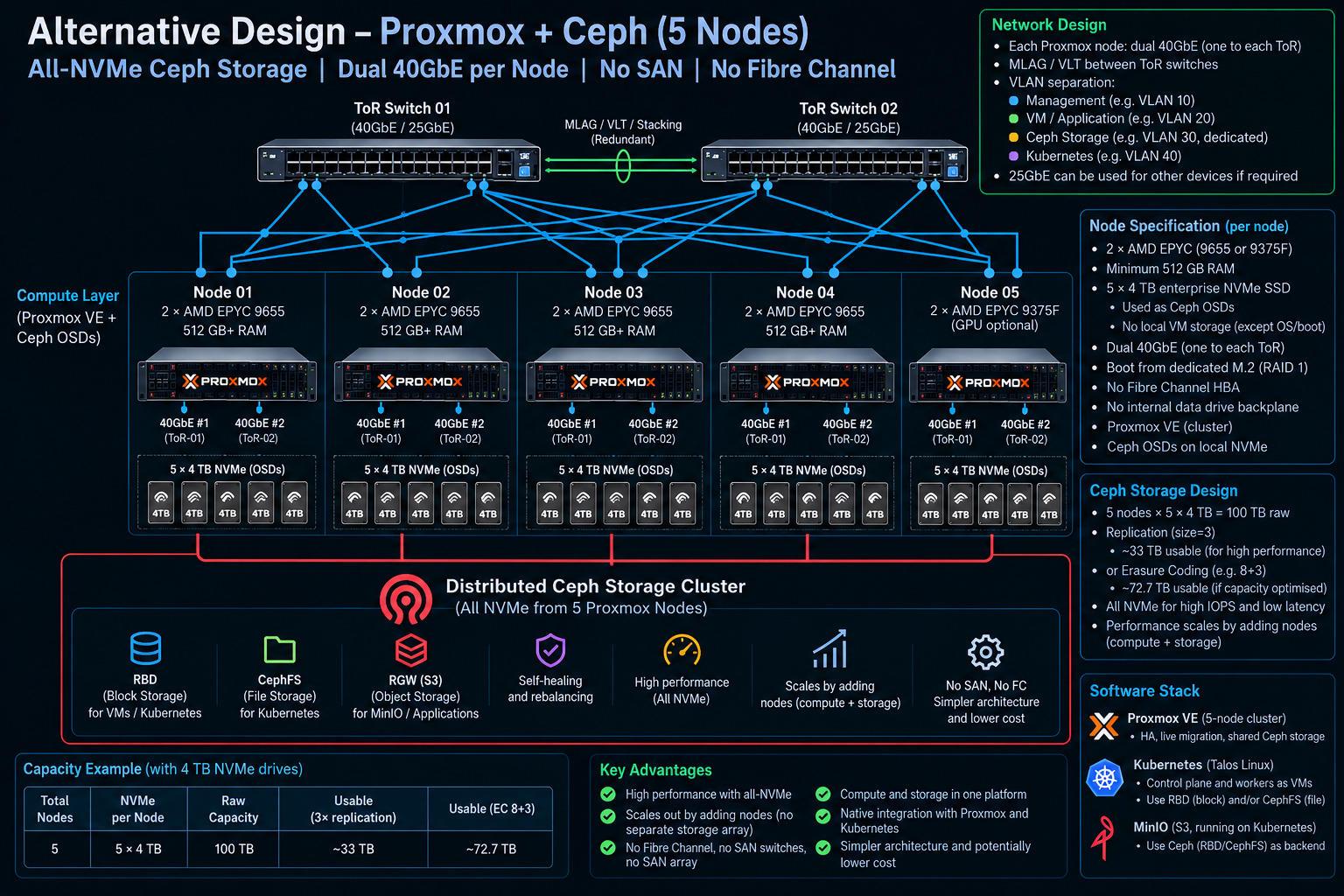
A production-grade, licence-free virtualization stack engineered by Tuah Packet: Proxmox VE compute, self-healing Ceph software-defined storage, Proxmox Backup Server immutability, and a 25G/100G zero-trust fabric - with a documented migration path off Broadcom VMware.
Every component is open, auditable, and independent - no per-core licensing, no vendor lock-in.
Enterprise hypervisor running full KVM virtual machines and lightweight LXC containers, with live migration, integrated HA manager, and the Corosync-based cluster quorum.
Distributed, software-defined storage with 3× replication or erasure coding. The CRUSH map rebalances automatically when a node or OSD is lost - zero storage outage on failover.
Deduplicated, client-side-encrypted, ransomware-immutable backups with instant restore and verification - the foundation of the DR architecture.
Spine-leaf switching, RoCE/low-latency Ceph interconnect, segmented management/compute/storage VLANs, and micro-segmentation aligned to zero-trust principles.
Indicative Proxmox HCI cluster sizes. Final BOM is produced from your assessment and configurator output.
| Tier | Compute Nodes | vCPU / RAM | Ceph Raw / Usable | Fabric | Fault Tolerance |
|---|---|---|---|---|---|
| Starter HA | 3 × Proxmox nodes | 96 vCPU / 768 GB ECC | 46 TB / 15 TB | Dual 25GbE RoCE | 1 node / 4 OSDs |
| Growth | 5 × Proxmox nodes | 320 vCPU / 2.5 TB ECC | 150 TB / 50 TB | Dual 25GbE RoCE | 2 nodes / 8 OSDs |
| Enterprise | 8 × Proxmox nodes | 768 vCPU / 6 TB ECC | 480 TB / 160 TB | Dual 100GbE Spine-Leaf | 2 nodes / 16 OSDs |
What changes when you move off per-core subscription licensing.
| Dimension | Broadcom VMware | Tuah Packet Proxmox HCI |
|---|---|---|
| Licensing model | Per-core subscription, mandatory bundles | Open-source, no per-core licence |
| Cost trajectory | Multiplied after Broadcom acquisition | Predictable - hardware + support only |
| Storage | vSAN (separate licence tier) | Ceph SDS built-in, self-healing |
| Backup | Third-party + separate licensing | PBS dedupe, immutable, encrypted |
| Vendor lock-in | High | Low - open, portable, auditable |
| Local support | Vendor / distributor chain | 4-hour on-site SLA from Bangi, MY |
Estimate your 3-year savings by migrating your virtualized workloads to Tuah Packet Turnkey Proxmox HCI.
Get a sized Proxmox HCI blueprint and a costed migration proposal - then see exactly how we deliver it.
Connect with the Tuah Packet engineering team for a migration assessment or a full architecture blueprint.